

The FY2026 tax reform introduced a new special provision governing the organization and retention of documents relating to related-party transactions (the “Regime”).
Where the contracts, purchase orders, invoices and similar records already held in respect of an intra-group transaction — whether between a parent and its subsidiary or between sister companies — do not set out the information needed to understand how the consideration was calculated, the Regime requires the corporation to obtain or prepare, and then retain, documentation that supplies what is missing.
At first sight this appears to be no more than a record-keeping rule. In practice, its significance lies elsewhere: a failure to comply may constitute grounds for revocation of blue return filing status, which makes the practical impact of this reform considerable.
This article summarizes the key features of the new Regime.
On 30 June 2026, the National Tax Agency (NTA) published its Administrative Guidelines on the operation of the Regime, together with amendments to the Corporation Tax Basic Circular introducing a new Chapter 17, Section 3 (paragraphs 17-3-1 to 17-3-11).
These clarify the level of detail expected, the treatment where documentation has not been retained, and how the Regime will be applied in the course of a tax examination. For details, see “NTA Administrative Guidelines and Basic Circular (30 June 2026)” below.
Background to the Regime
Transactions carried out within a corporate group — and in particular shared-cost arrangements, under which the costs of R&D, advertising, systems maintenance and similar centralized functions are allocated among group members — share a common characteristic: the basis on which the charge is determined is rarely visible from outside the group.
In practice, intra-group charges are frequently supported by no more than an invoice, or by a single “lump sum” line item. Cases in which the tax authorities were unable, in the course of a tax examination, to establish how a charge had been calculated, and therefore unable to verify whether the amount paid was appropriate, had come to be regarded as a problem.
Against that background, and with a view to securing the proper determination of taxable income, the Regime has been introduced as a mechanism requiring a defined set of documents relating to related-party transactions to be organized and retained.
Overview of the Regime
The basic mechanics of the Regime are as follows.
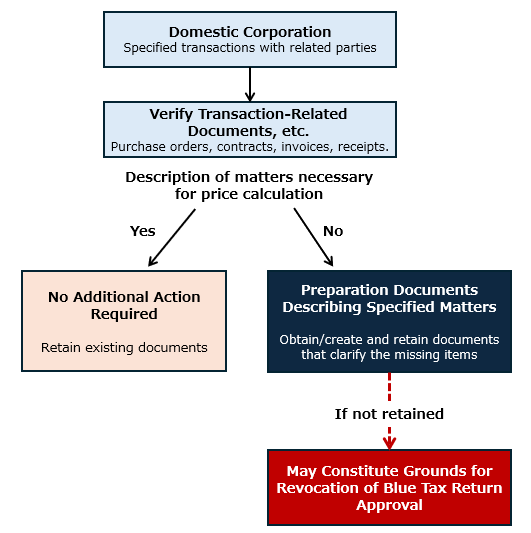
Where a domestic corporation enters into a “specified transaction” with a related party, and the transaction-related documents already held — purchase orders, contracts, invoices and the like — do not contain the information necessary to determine how the amount of the consideration was calculated, the corporation must obtain or prepare, and retain, documentation setting out those missing items (“specified matters documentation”).
The information specifically required is as follows.
- Details of the assets transferred or the services provided under the transaction
- Details of the calculation of the consideration payable under the transaction, and related matters
The key point here is that the Regime does not require the taxpayer to demonstrate that the price is appropriate by reference to comparable third-party transactions.
What the Regime is directed at is ensuring that it is possible to understand how the consideration in question was arrived at.
Unit prices and other terms of the transaction, the method of calculation, and the period or timing over which the services were provided must be apparent from the documentation. A statement addressing the appropriateness of the resulting amount is not required. (That the documentation need not address appropriateness plainly does not mean that the pricing need not be appropriate. The arm’s-length nature of the charge remains a matter to be managed separately.)
Corporations within scope
The Regime applies to domestic corporations; foreign corporations are outside its scope. It applies irrespective of whether the corporation files a blue return.
Because the Regime is directed at domestic corporations, the Japan branch of a foreign corporation is not covered.
Scope of “related parties”
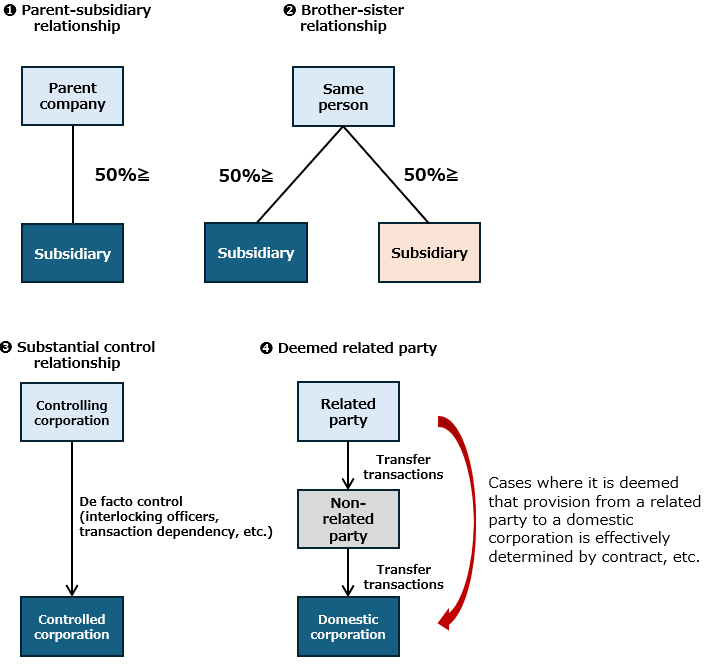
A “related party” for the purposes of the Regime is determined on the same basis as under the transfer pricing rules.
In broad terms, corporations standing in the following relationships are covered.
- Direct or indirect ownership of 50% or more of the issued shares (parent–subsidiary relationship)
- Corporations 50% or more of whose issued shares are directly or indirectly held by the same person (sister-company relationship)
- A relationship in which one corporation substantially controls the other (de facto control relationship)
- Relationships arising through a chain of the above
Whereas the transfer pricing rules apply to “foreign related persons,” the Regime is distinctive in that it extends more broadly, capturing transactions between domestic corporations as well.
Covered “specified transactions”
“Specified transactions” are limited to the following categories of transaction giving rise to selling, general and administrative (SG&A) expenses and other costs.
Note also that a specified transaction is limited to a transaction carried out by the related party for the benefit of the domestic corporation.
(i) Transfer or licensing of industrial property rights, etc.
- Patents, utility model rights and other rights in technology, production methods based on special technology, and similar rights
- Copyrights (including publication rights and neighboring rights)
- Computer program works
(ii) Prescribed services
- Business activities such as R&D and advertising carried out using the management resources of the related party
- Making assets dedicated to the related party available for use, and the maintenance and management of those assets
- Management of, or guidance on, the business, and the provision of information and similar services drawing on the knowledge and experience of the related party
- The Regime captures a wide range of transactions that arise routinely within groups — management fees, technical assistance fees, marketing support, accounting, tax and legal support, systems maintenance, royalties and outsourcing fees
- Transactions giving rise to cost of sales, by contrast, are outside scope
Consequences of non-compliance
The most significant practical feature of the Regime is the consequence attaching to a failure to comply with the retention obligation.
Where the specified matters documentation has not been retained, the amount paid under the transaction is not thereby automatically treated as non-deductible. What is of far greater significance is that non-compliance may constitute grounds for revocation of blue return filing status.
Where blue return status is revoked, the corporation becomes a white return filer and loses the benefits attaching to blue return status — including the carryforward of net operating losses and access to special depreciation and tax credit regimes.
The exposure is not the disallowance of a single item of expense. It extends to blue tax return status as a whole, and that is where the real weight of the Regime lies.
The Administrative Guidelines published on 30 June 2026 set out the authorities’ approach to revocation.
Revocation will not follow automatically from the mere absence of documentation. At the same time, a further consideration — the effect on the carryforward of net operating losses — has now been made explicit.
NTA Administrative Guidelines and Basic Circular (30 June 2026)
On 30 June 2026, the NTA published Administrative Guidelines on the operation of the Regime and amended the Corporation Tax Basic Circular to introduce a new Chapter 17, Section 3, “Special provision for the organization and retention of documents relating to related-party transactions” (paragraphs 17-3-1 to 17-3-11).
When the Regime was first enacted, a number of questions were left open:
“How much detail is enough?”
“What actually happens if the documentation has not been retained?”
“How will the Regime be applied in the course of a tax examination?”
The June publication answers these questions in concrete terms, setting out the authorities’ approach to the operation of the Regime.
The points of greatest practical significance are summarized below.
- The absence of documentation does not of itself result in disallowance or in revocation of blue return status (a graduated approach applies)
- The level of detail required is that which allows a third party to understand the transaction objectively
- Specified matters documentation need cover only the “missing” items; multiple documents may be read together, and a simplified approach is available for recurring transactions
- Where the transfer pricing Local File already contains the required information, the Regime does not apply
- The retention of documentation is also relevant to the record-keeping condition for the carryforward of net operating losses
Effective date and retention period
The Regime applies to related-party transactions carried out in fiscal years beginning on or after 1 April 2026. For a March year-end corporation, the year ending 31 March 2027 will be the first year of full application.
The retention period is seven years, running from the day falling two months after the last day of the fiscal year (or the equivalent date).
Practical steps
Preparing for the Regime is likely to involve the following steps.
Step 1 is to identify the related parties.
Working from the list of group companies, the corporations that constitute related parties for the purposes of the Regime need to be identified. Where the group is large, or where transactions are conducted through third parties, deemed related parties must also be captured.
Step 2 is to identify the transactions in scope.
Of the transactions taking place within the group, those constituting specified transactions need to be identified. Shared-cost arrangements, royalties and management fees warrant particular attention.
Step 3 is to review the existing transaction-related documents.
Existing contracts, invoices and similar records should be reviewed to confirm whether they cover the information required in relation to the calculation of the consideration, and supplementary documentation prepared where they do not.
Step 4 is to prepare the documentation and establish the internal processes.
Where gaps exist, documentation will need to be prepared. This is not a matter for the finance function alone: a workflow governing the preparation and retention of the documentation should be established in cooperation with the relevant business units and the legal function.
Closing comments
Although the Regime takes the form of a record-retention obligation, non-compliance can carry the significant consequence of revocation of blue return filing status.
Its scope is not limited to large corporations: every domestic corporation entering into related-party transactions is within scope, so a response is required across the corporate spectrum, including smaller companies.
Particular attention is warranted in relation to transactions between Japanese subsidiaries of foreign corporations and their overseas affiliates, management fees charged to subsidiaries acquired through M&A, and shared-service arrangements established following a group reorganization. In each case the state of the contracts and supporting calculations should be reviewed afresh, and the necessary steps taken before the Regime takes effect.
The Administrative Guidelines and Basic Circular published on 30 June 2026 have made clear that the Regime is not intended to operate on a “disallow and revoke immediately” basis, but on a graduated basis that affords an opportunity to remedy.
That said, with the effect on the carryforward of net operating losses now made explicit, the importance of proper documentation has, if anything, increased.
At the same time, the guidance identifies real scope for an efficient response — the elimination of duplication with the Local File, and the simplified treatment of recurring transactions. What is called for is a calibrated response that reflects the profile of the group’s transactions and the documentation already in place.
If you would like to discuss the points your own group should be alert to, or how best to respond in practice, please feel free to get in touch.
* * * * * * * * * * * * * * * * * * * * * *
This article sets out general treatment only and includes the author’s personal views, and conclusions may differ depending on the particular facts and circumstances. Before taking any decision or action on the basis of this article, we recommend that you consult a tax professional.
We would of course be pleased to discuss any of these matters with you — please feel free to get in touch.
Copyright in the tables and images contained in this article belongs to us, and reproduction, duplication or citation without permission is prohibited. If you wish to cite this article, please indicate the source and contact us in advance.