

When a foreign parent company transfers the shares of its Japanese subsidiary, it is tempting to assume that, because the seller is a foreign corporation, the transaction has nothing to do with Japanese tax issues.
In certain cases, however, the foreign parent company may be subject to capital gains tax in Japan.
This article summarizes one of the issues that frequently arises in cross-border transactions: a transfer of shares that falls within the so-called “25/5 rule”.
What Is the 25/5 Rule?
Under Japanese domestic tax rules, a non-resident shareholder — such as a foreign corporation — without a permanent establishment (“PE”) in Japan is generally not subject to Japanese tax on capital gains arising from a disposition of shares in a Japanese company, unless a specific exception applies.
One of the most important exceptions is a transfer that satisfies both of the following requirements, commonly referred to as the “25/5 rule”:
- At any time during the three-year period ending on the last day of the fiscal year of transfer, the foreign corporation, together with its specially related shareholders, etc., owned 25% or more of the total issued shares of the Japanese company; and
- During the fiscal year of transfer, those specially related shareholders, etc., transferred 5% or more of the total issued shares of the Japanese company.
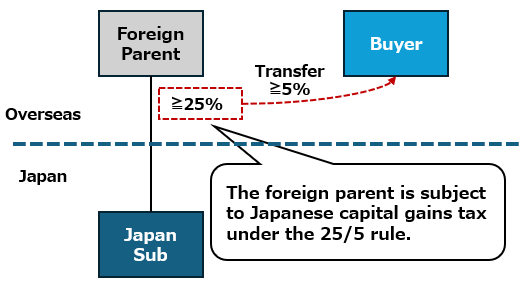
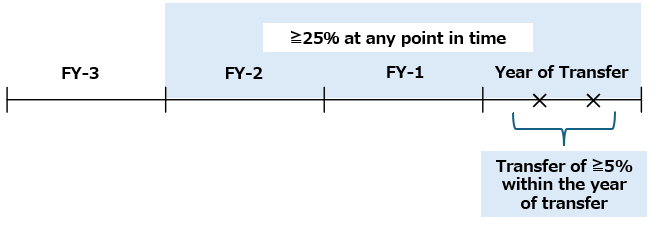
Where both requirements are met, the gain is treated as Japan-source income, and the foreign corporation is subject to Japanese taxation regardless of whether it has a PE in Japan.
This is why the rule is commonly referred to as the “25/5 rule.”
Override Under an Applicable Tax Treaty
The 25/5 rule is a rule under Japanese tax law.
Where an applicable tax treaty provides otherwise, however, the treaty takes priority over domestic law.
Accordingly, it is necessary to review the tax treaty between Japan and the country where the transferring foreign corporation is resident. If that treaty contains a provision addressing gains within the scope of the 25/5 rule, the treaty provision will prevail over the domestic rule.
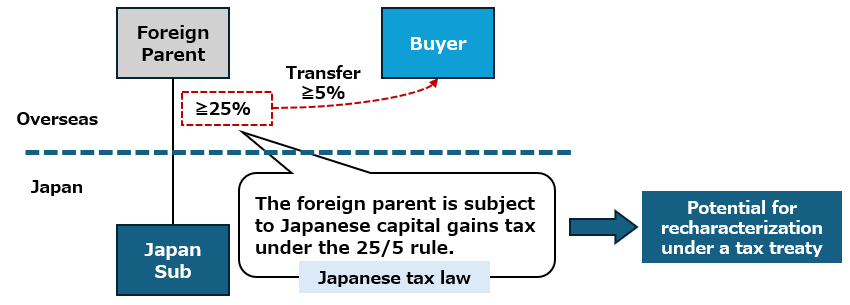
Because the tax treaties of some countries exempt such gains from Japanese taxation, this point must be reviewed carefully.
Examples of Treaty Application
United States. Under Article 13 of the Japan-U.S. Tax Treaty, gains within the scope of the 25/5 rule are not taxable in Japan as the source country, provided that the relevant treaty requirements — including the limitation on benefits article — are satisfied.
Singapore. Under Article 13 of the Japan-Singapore Tax Treaty, gains within the scope of the 25/5 rule may be taxed by Japan as the source country.
As shown above, treaty provisions differ significantly from country to country. Moreover, even where a treaty contains a relevant provision, some treaties impose additional conditions (such as a limitation on benefits article) that must be satisfied before treaty benefits can be claimed. The position therefore varies considerably depending on the country.
Where treaty benefits are available, they generally must be claimed by filing the appropriate treaty forms with the Japanese tax office in a timely manner — for example, Form 15 (Application Form for Income Tax Convention) and, for treaties containing a limitation on benefits article such as the Japan-U.S. Tax Treaty, Form 17 (Attachment Form for Limitation on Benefits Article). For non-resident corporations, these forms are generally required to be filed within two months from the end of the fiscal year of the share sale.
Summary
As described above, when a foreign corporation transfers shares in a Japanese company, the transfer may fall within the 25/5 rule and give rise to Japanese taxation, so care is required.
Although an applicable tax treaty may override the domestic rule and exempt the gain from Japanese taxation, treaty provisions vary significantly from country to country. Unless careful attention is paid to how the relevant treaty is worded, whether the treaty can be applied to the specific case, and what procedures are required in order to apply it, unexpected Japanese taxation may arise.
In cross-border share transfers, we recommend reviewing the Japanese tax implications early, from both a domestic law and a tax treaty perspective, taking into account the country where the foreign corporation is resident, its ownership ratio, and the percentage of shares transferred.
Our office advises foreign-owned groups and overseas parent companies on the Japanese tax treatment of share transfers, including 25/5 rule and tax treaty analysis and, where a filing is required, acting as tax agent and preparing the necessary returns and forms.
If you have any questions regarding Japanese tax matters in connection with a share transfer involving a foreign-owned Japanese company, please feel free to contact us.
***************
This article provides general information only and may include personal views. The conclusion may differ depending on the specific facts and circumstances. Before making any specific decision or taking any action based on this article, you should consult a tax professional.
Our office is available for consultations, so please feel free to contact us.
If you have questions such as “How would this apply to our company’s situation?” or “We would like to discuss a more specific case,” please feel free to contact us.
We also welcome discussions with fellow professionals, as well as spot consultations and collaboration opportunities.
The copyright in the tables and images included in this article belongs to our office.
Unauthorized reproduction, duplication, or quotation is prohibited. If you wish to quote this article, please clearly indicate the source and contact us in advance.